58% of Your Shoppers Are Begging You to Sell Them More
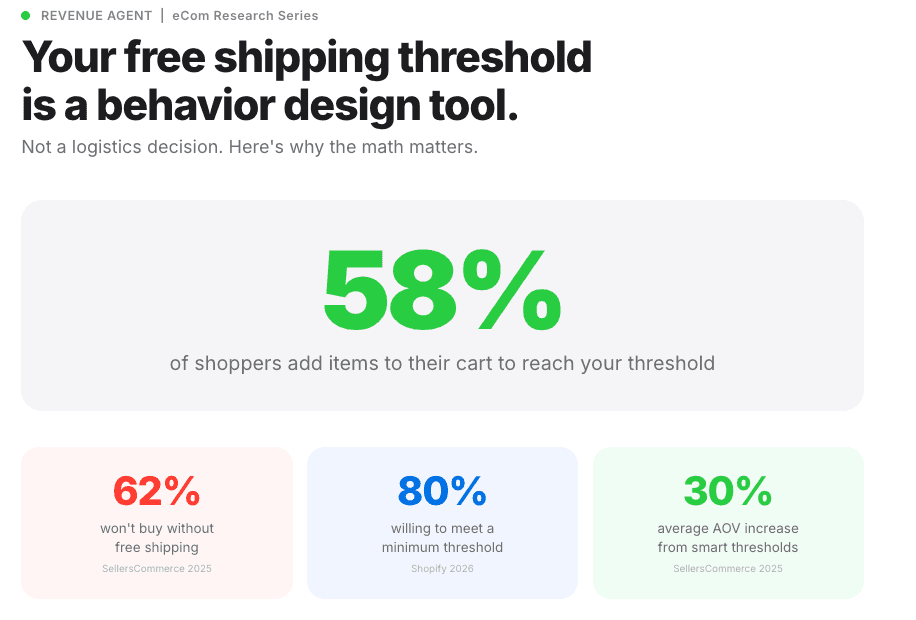
58% of your shoppers are literally adding items to their cart just to reach your free shipping threshold.
Not because they need those items. Because free shipping activates the same neural reward pathways as getting a gift. MIT research found that the word "free" makes people behave irrationally. They'll add a $12 item to save $7 in shipping and feel great about it!
This means your free shipping threshold is the most powerful behavior design tool in your store. (And you probably set it two years ago based on gut feel, didn’t you)
Let me walk through the research.
SellersCommerce ran a comprehensive study in 2025 on shipping behavior. Three numbers jumped out:
62% of shoppers won't complete a purchase if shipping isn't free. (You're losing more than half your potential customers at checkout.)
58% will actively add items to their cart to qualify for free shipping. They just need the right target.
30% average AOV increase from strategically set thresholds. Not from ads or new products. From changing a single number.
Here's where it gets interesting:
Say your AOV is $50 and your shipping costs $8 per order.
If you set your threshold at $65 (30% above AOV), here's what happens:
About 58% of your customers (give or take) will stretch to reach $65. They add a $15 item. Your gross margin on that extra $15 is about $6 (at 40% margins). You absorb $8 in shipping. Looks like you lost $2 per order, right?
Nope.
Because you're also converting customers who would have abandoned carts. Baymard's data shows 39% of cart abandonments do so because of extra costs at checkout. If your free shipping threshold converts even a fraction of those abandoners, each one represents $26 in margin ($65 × 40%) minus $8 in shipping = $18 in profit that didn't exist before.
The math on one mid-size brand we looked at:
Changed $50 free shipping → $65
Lost ~$2/order on existing customers who were already converting
Gained $18/order on customers who would have abandoned
Net impact: $40K/month in recovered revenue
The fix took <5 minutes!
So what's the right number?
The research converges on 15-25% above your current AOV. This range is cited by Shopify, Red Stag Fulfillment, Rework, and EcomHint independently.
This range works because it's high enough that customers need to add an item (which changes behavior), but low enough that the goal feels achievable. Go below 15% and there's no behavioral pull. When we go above 30%, the customers give up.
One case study saw a 70% conversion drop when they set the threshold too aggressively.
There's a benchmark to check if yours is right: Intelligems (who've run thousands of these tests across Shopify stores) says your checkout-to-purchase rate should be 45-60%. Below 45%? Your threshold is probably hurting conversion, not helping it.
Three things you can do immediately:
Check when you last changed your free shipping threshold. If the answer is "I don't remember" or "more than 6 months ago," it's almost certainly suboptimal. Your AOV has probably shifted, your product mix has changed, and customer behavior is different.
Look at your checkout-to-purchase rate. If it's below 45%, your threshold might be set too high. If over 65% of orders qualify for free shipping, it might be too low.
Add a progress bar or dynamic message showing how close customers are to free shipping (love this one). Rework research found these visual indicators increase threshold conversion by 15-25% compared to static messaging. Most Shopify apps can add this in minutes.
I spent 5 years at Google watching brands spend millions optimizing their ad spend for marginal gains. Then I started scanning Shopify stores and found that a 10-minute shipping threshold change could outperform a month of ad optimization.
The irony isn't lost on me.
Your shipping threshold isn't a logistics decision. It's the single most underleveraged revenue tool in your store.
When was the last time you looked at yours?

