A Framework for Thinking About Promo Timing (That Isn't Just 'Run BFCM')
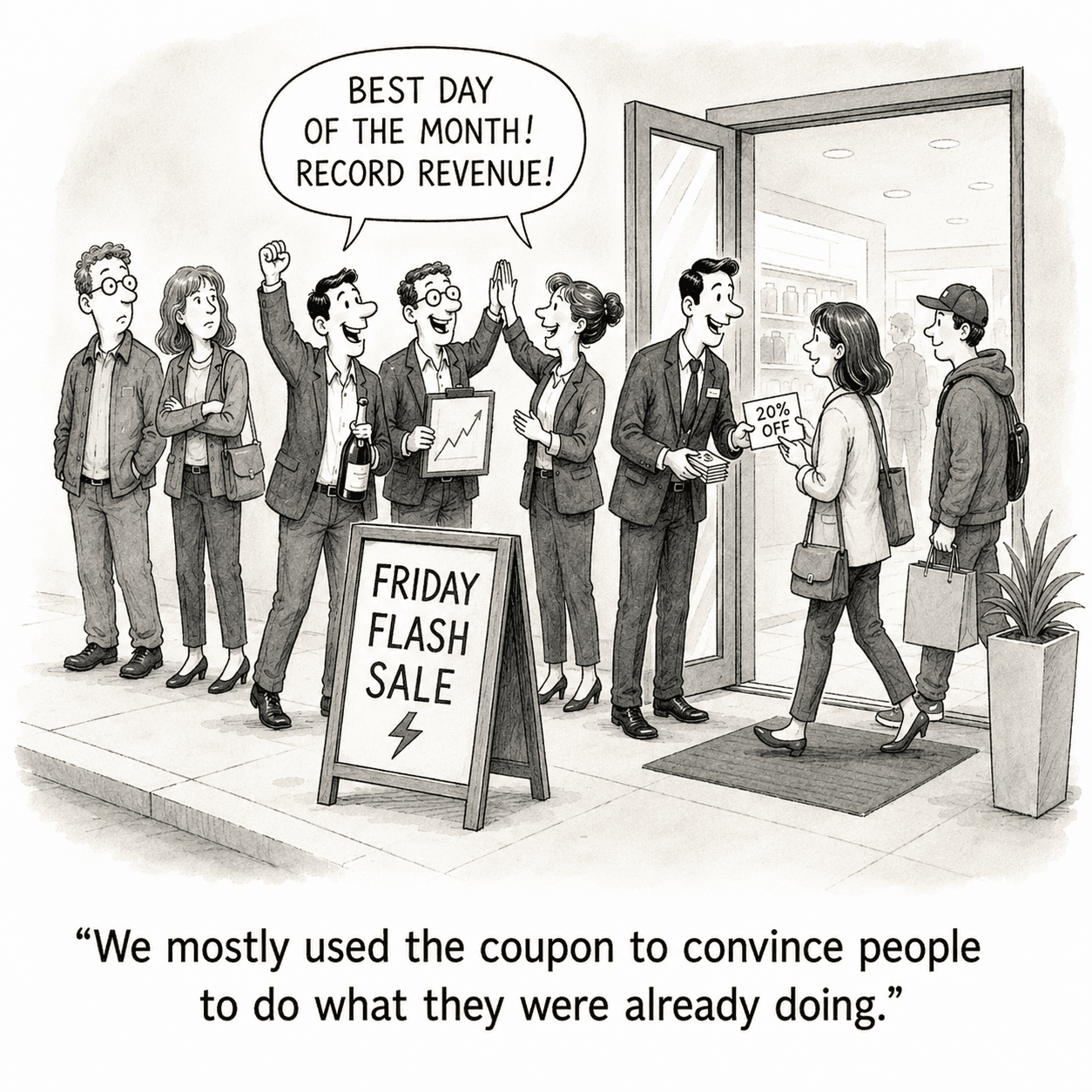
"We ran 15% off last Friday and hit our best revenue day of the month."
We hear some version of this all the time. And the eCom team celebrates. But we want to push on what "best revenue day" actually means.
Was Friday your best revenue day because the promo drove incremental purchases? Or was Friday already your highest-traffic day, and the promo just discounted people who were going to buy anyway?
This distinction is worth real money. And most brands never check.
When we scan stores and overlay their promo calendar against their traffic data, a pattern shows up consistently: 40%+ of promotional revenue at some brands occurs during naturally high-traffic periods.
That doesn't mean the promo was worthless. But it raises a question: what percentage of those sales would have happened at full price?
If your site gets 5,000 visitors on Friday and 2,000 on Tuesday, and you run 15% off on Friday, you're subsidizing the 5,000 visitors who were already showing up. Some of them needed the push. Many didn't.
We want to offer a framework that's more useful than "stop running promos during peak traffic." Because the reality is more nuanced than that.
There are two types of promos, and they need different strategies.
Type 1: Tentpole promos. Black Friday, Memorial Day, Back to School, Valentine's Day. These are non-negotiable. Your competitors are running them. Customers expect them. If you don't participate, you lose share of wallet during the biggest spending periods of the year. The goal with tentpole promos isn't incrementality - it's competitiveness. You're not trying to change behavior. You're trying to win your share of demand that exists regardless. Run them. Don't overthink it.
Type 2: Brand-initiated promos. The ones your team creates on your own calendar. Flash sales, end-of-season clearance, "treat yourself" campaigns, loyalty offers, mid-month pushes. These are the promos where incrementality actually matters.
Most of the waste I see comes from Type 2 promos that are mistimed.
Here's the framework I'd suggest for Type 2 promos.
Map your traffic by day of week and time of day. Pull 8-12 weeks of data from Google Analytics. Identify your natural peaks (probably Friday-Sunday) and your natural valleys (probably Tuesday-Wednesday, midday).
Step 2: Map your existing promo calendar on top of that traffic data. Where do most of your promos land? If they cluster around peaks, you're likely subsidizing existing demand.
Step 3: Test shifting non-tentpole promos to valleys. Instead of running 15% off on Friday (your highest traffic day), try running it on Tuesday afternoon (your lowest). The math might surprise you.
Here's why this works: on a high-traffic day, most visitors were coming anyway. A discount converts some who were on the fence, but it also gives away margin to many who would have bought regardless. On a low-traffic day, the discount is doing more of the heavy lifting. A larger percentage of conversions are truly incremental.
The absolute numbers will be smaller (fewer visitors on Tuesday), but the incrementality rate is much higher. And when you do the margin math, accounting for the discount you're NOT giving away on Friday, the net impact can be positive.
Let me be precise about what we're NOT saying.
We're not saying don't promote during peaks. For tentpole events, you should.
We're not saying Tuesday promos will generate more revenue than Friday promos. They almost certainly won't in absolute terms.
We're saying: audit your Type 2 promos for incrementality. Ask yourself for each one - did this promo change behavior, or did it discount behavior that was already happening?
If you ran 12 non-tentpole promos last year and 8 of them were timed during natural traffic peaks, there's probably a meaningful reallocation opportunity. Shift some of that promotional budget to low-traffic periods and measure whether you're getting more incremental revenue per discount dollar.
The self-check:
Pull your promo calendar from last year. For each non-tentpole promo, check what day of the week and time it ran. Then check: was that a peak traffic period for your store?
If most of your discretionary promos clustered around your highest-traffic periods, you have an opportunity to improve incrementality.
The goal isn't fewer promos. It's better-timed promos.

