How to Find Your Best Bundle Opportunities Using Data You Already Have
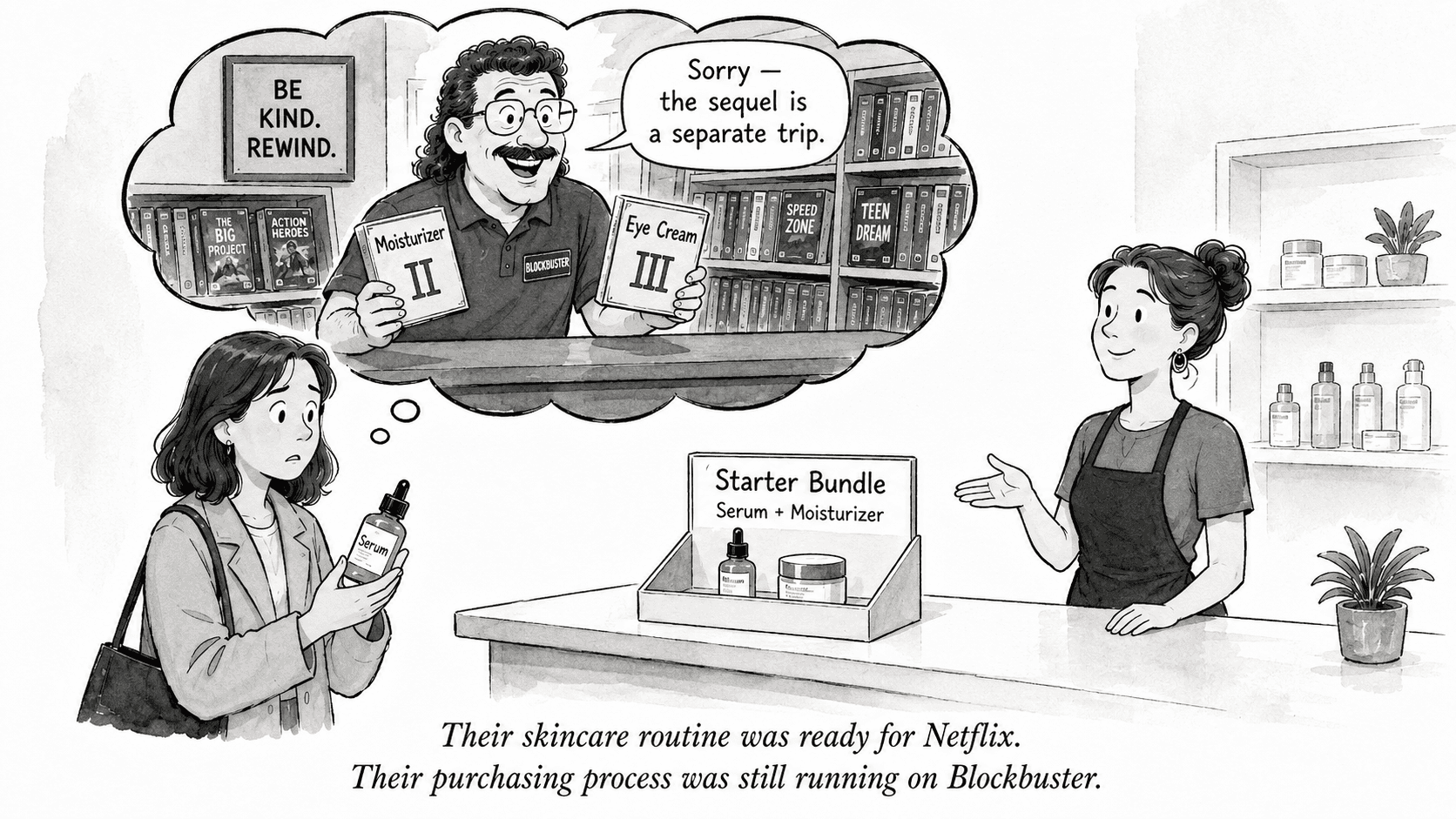
Bundling is one of those things everyone agrees they should do more of. McKinsey research shows bundles boost sales by 20% and profits by 30%. Forrester found cross-selling drives 10-30% of total eCom revenue. Bundle customers have 2.7x higher lifetime value.
And yet, when I ask eCom teams how they decide what to bundle, the answer is almost always some version of "the merchandising team picks what feels right."
Here's a three-step method for finding bundle opportunities using data that's already in your Shopify store.
Step 1: Pull your co-purchase data (the 60-day window)
This is the most underused report in eCom analytics. You want to know: when a customer buys Product A, what do they buy within 60 days?
In Shopify, you can't pull this natively (it's one of the more frustrating gaps in the analytics). But you can export your order data and run a simple analysis. Export all orders from the last 12 months. For each customer, look at which products they purchased across multiple orders within a 60-day window.
What you're looking for: product pairs that show up together significantly more than chance. If 30% of customers who buy your face serum also buy your moisturizer within 60 days, that's a bundle candidate. If 5% buy both, it's probably just noise.
The 60-day window matters because it captures genuine complementary use patterns, not just same-session impulse adds. These are products customers actually use together.
A quick rule of thumb: if 15%+ of buyers of Product A also buy Product B within 60 days, that pair is worth testing as a bundle.
Step 2: Analyze first-purchase to second-purchase sequences
This is even more valuable than co-purchase data because it tells you the natural "next step" in your customer journey.
Pull your repeat customer data. For each customer who made at least 2 purchases, look at what they bought first and what they bought second.
The insight: the most common first-to-second sequence is your natural "starter kit." If 40% of repeat customers buy Product X first and Product Y second, you should be selling X+Y as a bundle to first-time buyers. You're compressing two transactions into one, increasing AOV and accelerating the customer journey.
This is particularly powerful for consumable categories (supplements, skincare, food) where there's a natural discovery sequence. Customers try the entry product, like it, then explore. A bundle that mirrors this natural sequence feels helpful, not pushy.
Step 3: Pair high-margin slow movers with popular items
This is the most counterintuitive step and often the most profitable.
Look at your catalog and identify products that have good margins but low velocity. Maybe it's a specialized accessory, a premium variant, or a complementary product that customers don't discover on their own.
Now pair it with your best sellers. The popular item drives the bundle purchase, and the slow mover gets distribution it wouldn't get otherwise.
Why this works economically
You can offer a bundle discount (say 10-15% off the combined price) and still improve total margin because the slow mover had zero chance of selling individually. Any contribution from the slow mover is incremental.
A skincare example: your hero moisturizer sells 500 units/month at $45. Your eye cream sells 30 units/month at $35. Bundle them at $68 (15% off $80). You lose $12 per moisturizer sale in discount, but you gain $35 in eye cream revenue you never would have had. Net margin: significantly positive.
A few things we've learned about what makes bundles fail.
The most common mistake: building bundles around what YOU want to sell, not what customers want to buy. If the data says customers pair your shampoo with your conditioner, don't bundle the shampoo with the hair mask because the hair mask has better margins. Follow the data.
Second mistake: pricing the bundle too aggressively. A 25-30% bundle discount sounds generous, but it trains customers to wait for bundles instead of buying individual items. 10-15% off the combined price is the sweet spot for most categories - enough to feel like a deal, not enough to cannibalize individual sales.
Third mistake: not testing. Like everything else in eCom, the bundle you think will work might not, and the unexpected one might be your best performer. Test 2-3 bundle configurations and let the data tell you.
The bottom line: your purchase data already knows what customers want to buy together. Most stores just never ask it.
What's your best-selling bundle right now? And did you pick it using data or intuition?

