The 1% Rule That Most eCom Brands Have Never Heard Of
Most DTC brands set their prices once (at launch) and never touch them again.
I know because I was one of those people. At Wella, we spent weeks agonizing over the initial price of a new product line. Then we launched it and moved on to the next fire. Pricing became a fixed input, not a variable we actively managed.
Turns out that's one of the most expensive mistakes in eCommerce.
McKinsey analyzed the income statements of S&P 1500 companies and found something that should make every eCom operator stop and think:
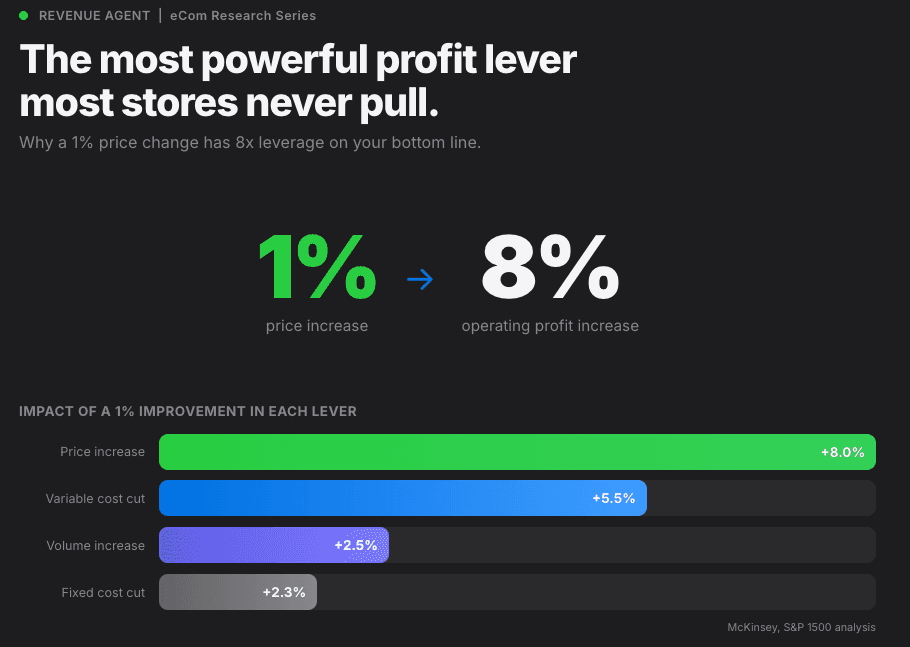
A 1% increase in price, with volume held steady, generates an 8% increase in operating profit.
That's worth reading again. One percent change in price leads to EIGHT percent profit increase.
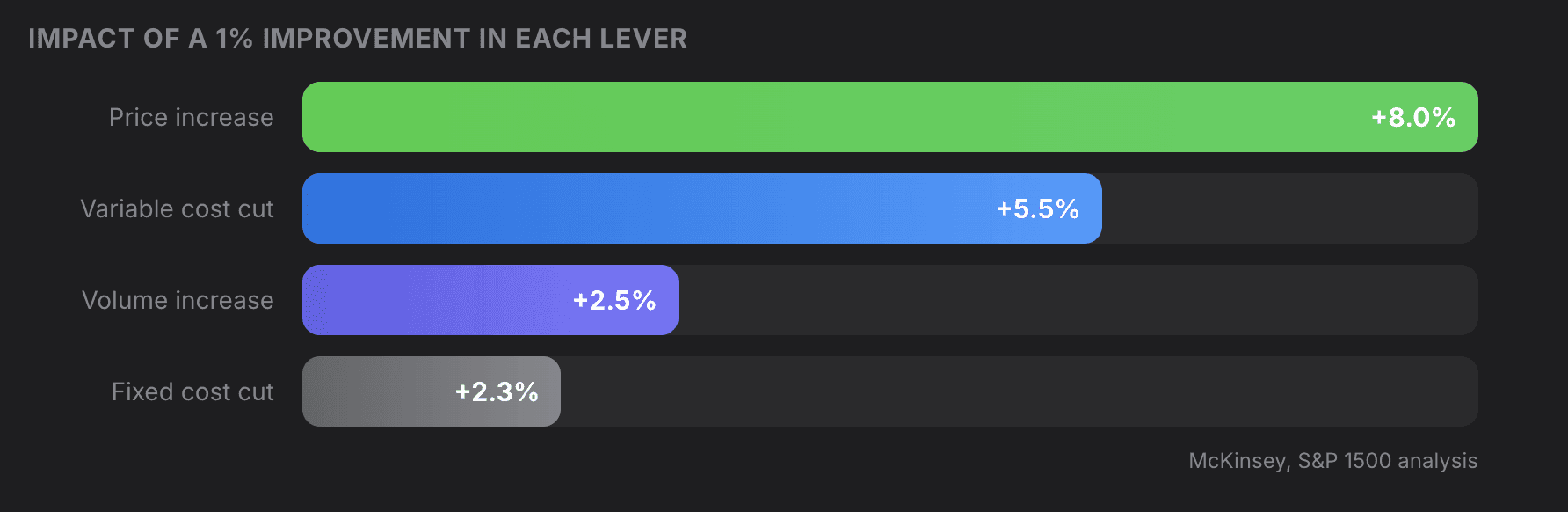
That's 50% more impactful than cutting your variable costs by 1%. And more than 3x the impact of increasing your sales volume by 1%.
The math is relatively straightforward. If your revenue is $10M and your operating margin is 12.5%, your operating profit is $1.25M. A 1% price increase adds $100K to revenue. If volume stays constant (Yes, big if), that $100K flows almost entirely to the bottom line (your costs don't change). Your new operating profit: $1.35M. That's an 8% jump.
The sword cuts both ways, by the way. A 1% price decrease? Operating profit drops 8%. And to offset a 5% price cut, you'd need to increase volume by 18.7%. That kind of demand sensitivity is extremely rare.
So why do so few DTC brands test their prices?
I think it comes down to three things.
First, fear. Raising prices feels risky in a way that running a new Facebook ad doesn't. There's a deep psychological resistance to it - "what if customers leave?" But the data says something interesting. Sheets & Giggles (a sustainable bedding brand) partnered with Intelligems to test three price points on their core products. The higher price group had no significant difference in conversion rate compared to the regular price group. Customers didn't flinch. The lower price group converted 40% better - but at the cost of margin. The sweet spot was higher than they thought.
Second, lack of tools. Until recently, running a proper price test on Shopify meant manually creating duplicate products or building custom code. It was painful enough that most people just... didn't. That's changing (Intelligems, Shoplift, and others now make it possible), but the muscle memory of "pricing is fixed" still dominates.
Third, the wrong mental model. Most operators think of pricing as a one-time decision: cost + margin + competitor check = price. But pricing is really a continuous optimization problem. Your customers' willingness to pay changes with seasons, with your brand equity, with what competitors do, with macroeconomic conditions. The price you set 18 months ago is almost certainly not optimal today.
Let's make the math concrete for a mid-size DTC brand.
Say you're doing $8M in revenue with a 40% gross margin and 12% operating margin.
Your operating profit is $960K.
Your top 10 SKUs probably represent 60-70% of your revenue. That's about $5.2M.
If you test a 3-5% price increase on those 10 products and find that even half of them can sustain a 3% increase without meaningful conversion loss (which the data suggests is likely), here's what happens:
Revenue on those 5 SKUs: $2.6M × 1.03 = $2.68M
Additional revenue: $78K
At 40% gross margin, some of that covers variable costs, but the incremental profit is significant
If you lose 1-2% of conversion (common in pricing tests), net impact is still strongly positive
Annualized profit impact: $50-80K in additional operating profit
That's a 5-8% increase in operating profit from testing prices on 5 products for a month. No new ad spend. No new products. No new hires.
And here's the part that blew my mind when I first ran these numbers: most brands have NEVER tested this. They're optimizing Facebook CPMs to save $0.50 (!!) while leaving $50-80K in pricing upside untouched.
There is some important nuance here. This isn't a "just raise your prices" post.
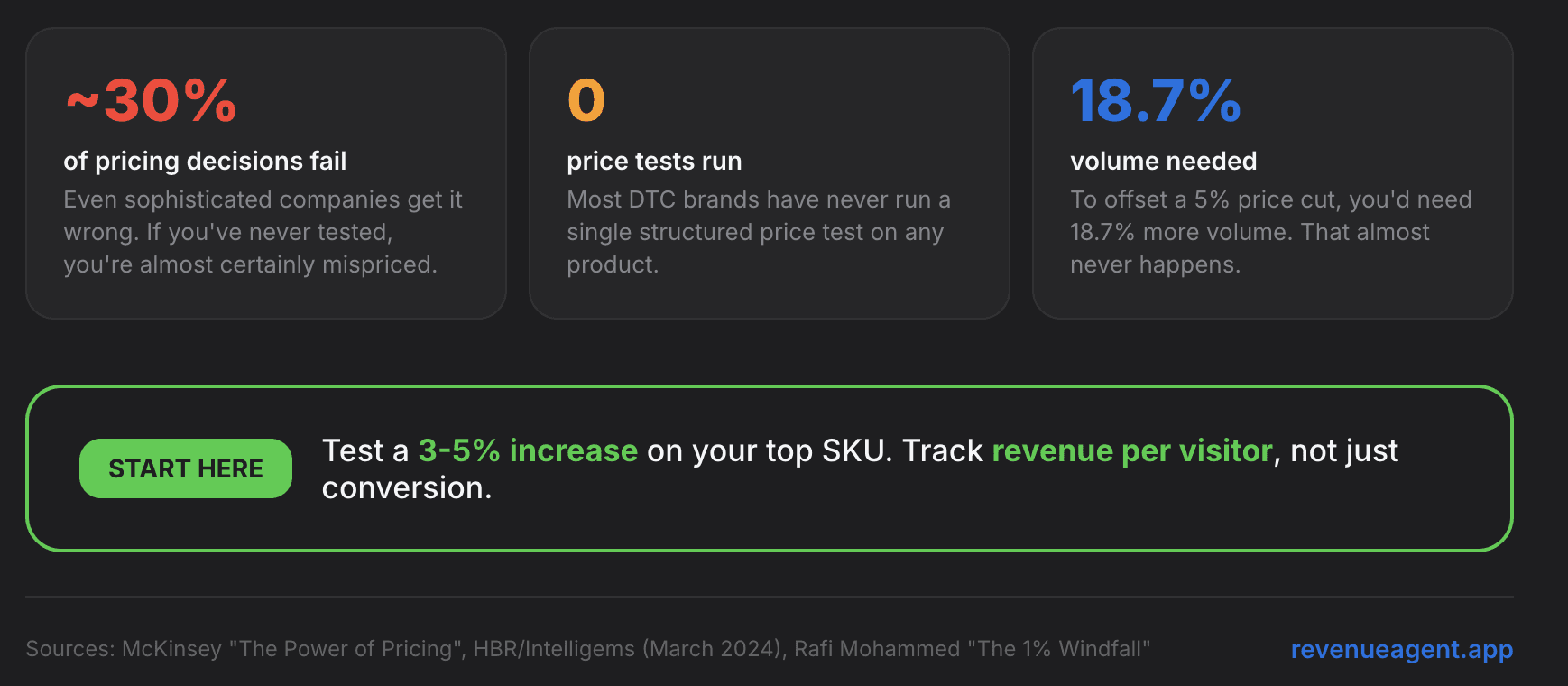
McKinsey's original finding was that ~30% of pricing decisions fail to deliver the best price. That means the best price could be higher OR lower. The point isn't directional - it's that you need a process for finding out.
Some of your products are probably underpriced. Your hero SKU, the one with brand loyalty and repeat purchases, might easily tolerate 5%. Customers buy it because they love it, not because of the price.
Some are probably overpriced. That accessory with a 2% conversion rate? Dropping the price might actually increase total margin if it pulls more people through the door.
The only way to know is to test. And most brands don't.
So, here's the three things you can do this week:
Pull your top 10 SKUs by volume. Look at each one and ask: when did we last evaluate this price? If the answer is "at launch" or "more than a year ago," you're almost certainly leaving money on the table.
Pick one product to test. Start with something high-volume where you have enough traffic for statistical significance (at least 1,000-5,000 visitors per variation over 2 weeks). Test a 3-5% increase. Watch conversion rate AND revenue per session - not just conversion alone.
Track the right metric. Conversion rate alone is misleading for pricing tests. A small conversion drop with a price increase can still be hugely profitable. Revenue per visitor or profit per visitor is what matters.
Pricing is the fastest and most effective way to increase profit. McKinsey said it. The data backs it up. And yet it's the one lever most eCom brands never pull.
What's your pricing process? Or is it more "gut feel + competitor check"?
Side note: Our app, Revenue Agent is officially live on the Shopify App Store this week (took SO long!!). If you want a free scan to see what pricing moves make sense for your store, you can run one here.

