The 15 Minute Revenue Audit: 3 Things You Can Check
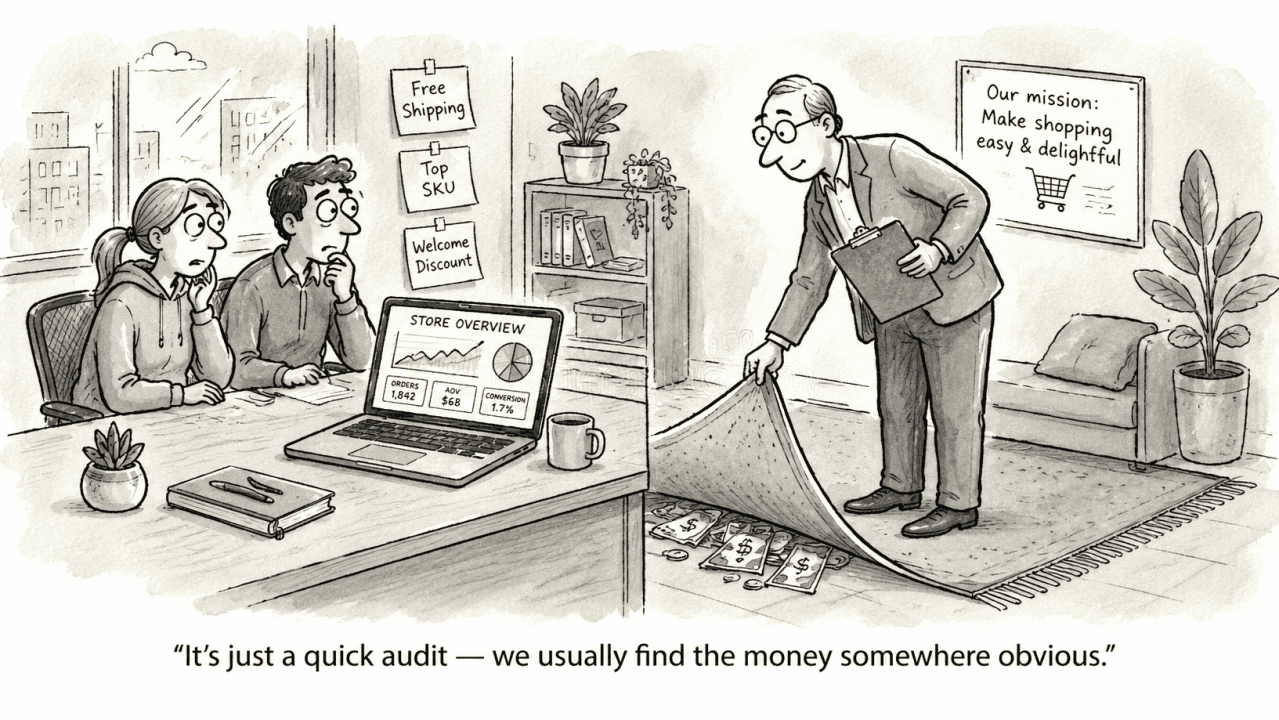
I've been scanning Shopify stores for the last 6 months. Most of the revenue opportunities I find can be identified with three checks that take 15 minutes total.
You don't need a tool for this. You just need your Shopify dashboard and 15 minutes on a Monday morning.
Here's the checklist I use.
Check #1: Your free shipping threshold vs your current AOV (5 minutes)
Go to Shopify Analytics → Reports → Average Order Value. Write down your current AOV.
Now go to Settings → Shipping and delivery. Look at your free shipping threshold.
The math is simple. Your threshold should be 15-25% above your AOV. If your AOV is $65, your threshold should be somewhere between $75 and $81.
Three things to look for:
If your threshold is BELOW your AOV: you're absorbing shipping on every order with zero behavioral lift. This is the most common mistake I see. One brand had a $50 threshold with a $62 AOV - most customers qualified for free shipping without adding anything. Moving to $65 recovered $40K/month.
If your threshold is more than 30% above your AOV: it's probably too aggressive. Customers see an unreachable goal and don't try. One case study saw a 70% conversion drop when the threshold was set too high. Intelligems says your checkout-to-purchase rate should be 45-60%. Below 45% means the threshold is hurting you.
If you haven't changed it in 6+ months: your AOV has almost certainly shifted. Product mix changes, price increases, seasonal patterns - all these move your AOV. A threshold that was right in January might be wrong in July.
Time: pull the two numbers, do the math. 5 minutes.
Check #2: Your top 10 SKU pricing (5 minutes)
Go to Products → sort by "Units sold" or pull a top sellers report from your analytics.
Look at your top 10 products by volume. These probably represent 60-70% of your revenue. For each one, ask one question: when did I last evaluate this price?
If the answer is "at launch" or "more than a year ago" - that's your opportunity. McKinsey's analysis of S&P 1500 companies found that a 1% price increase generates an 8% increase in operating profit. The leverage is enormous.
You don't need to change anything today. Just flag the ones that haven't been reviewed. Then pick one - your highest volume SKU - and ask yourself: if I raised this price 3-5%, would customers notice? Would they switch? Or would they keep buying because they love the product?
For most hero SKUs with strong brand loyalty, the answer is they'd keep buying. The Intelligems team has run thousands of pricing tests and consistently finds that higher price groups show no significant conversion drop for products with genuine brand value.
Time: pull the report, scan the list, flag the stale ones. 5 minutes.
Check #3: Your welcome discount usage rate (5 minutes)
This one requires a quick look at your email platform (Klaviyo, Omnisend, whatever you use) or your Shopify discount codes report.
Find the discount code from your welcome popup. Check how many first-time orders used it last month vs total first-time orders.
The benchmarks:
Below 30%: Your popup isn't visible enough or the offer isn't compelling. This means you're missing email captures and potentially losing hesitant visitors who needed a nudge.
40-60%: Healthy range. The discount is reaching people who need it without over-distributing.
60-70%: Watch closely. You might be giving the discount to some high-intent visitors who would have bought anyway.
Above 70%: You're almost certainly over-discounting. OpenSend data shows that direct traffic has a $115 AOV vs $86 for social traffic - that is a 32% gap. If you're giving the same 15% off to both, you're wasting margin on the high-intent visitor who typed your URL and came to buy.
The fix isn't removing the discount. It's targeting it. Show it to hesitant visitors (exit intent, time-on-site triggers) instead of everyone who lands on the page. The discount should change behavior, not reward behavior that was already happening.
Time: pull the redemption rate, compare to benchmarks. 5 minutes.
That's 15 minutes. Three numbers. And in my experience, at least one of them will surface an opportunity worth $20K-$100K+ per year.
The hard part isn't finding the opportunity. It's actually making the change. But at least now you know where to start!

