The $40K/Month Shipping Mistake We Keep Seeing
We've scanned dozens of Shopify stores in the last few months. And there's one mistake that shows up so consistently it almost feels like a rule:
The free shipping threshold is set below the AOV (Average Order Value).
Let me explain why this is a problem that's costing real money.
When your free shipping threshold is below your average order value, it means most customers are already qualifying for free shipping without adding anything to their cart. You're absorbing shipping costs on every order without getting any behavioral lift in return.
The whole point of a threshold is to pull customers to spend a little more. If they're already above it, there's no pull. You're just paying for shipping.
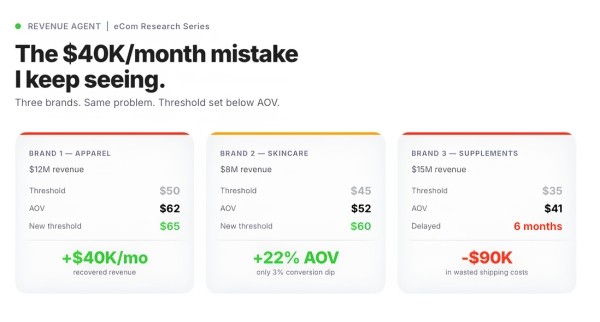
We saw this at one brand doing $12M in apparel. Their threshold had been $50 for two years. Their AOV had drifted up to $62 over that time as they added higher-priced items to the catalog. Nobody noticed. The threshold was set at launch and never revisited.
They moved it to $65. Revenue impact: $40K/month. The fix took 10 minutes.
I saw a variation of this at a skincare brand doing $8M. Their threshold was $45, their AOV was $52. Same problem, smaller gap, but compounded across thousands of orders. They moved to $60 and saw a 22% increase in AOV with only a 3% dip in conversion rate.
Third brand. Supplements. $15M. Threshold at $35, AOV at $41. They'd actually noticed the problem six months earlier - it was on someone's to-do list. But they were in the middle of a rebrand and a platform migration. By the time they got around to it, they'd given away roughly $90K in unnecessary shipping costs.
Here's the pattern.
Brand launches. Sets free shipping threshold based on cost analysis and AOV at the time. Maybe consults a few competitors and picks a round number.
AOV drifts upward over time. New products, price increases, inflation, category mix shifts. This happens naturally at almost every growing brand.
Nobody updates the threshold. Because it's not on fire. Because nobody's tracking it. Because the eCom team is busy with campaigns and launches and agencies.
The gap between threshold and AOV narrows. Then inverts. And every order that qualifies for free shipping without adding anything extra is a shipping cost you're eating for zero incremental revenue.
The fix is simple, but I want to be precise about it.
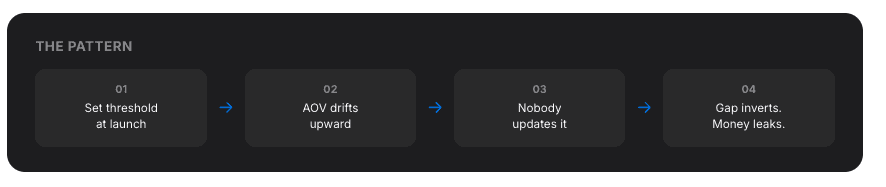
Image: Pattern seen for outdated free shipping levels
Don't just raise your threshold arbitrarily. Research converges on setting it 15-25% above your current AOV. That range creates enough of a gap that customers need to add an item (which changes behavior) but the target still feels achievable.
Then check your checkout-to-purchase rate. Intelligems, who've run thousands of shipping tests on Shopify, says healthy is 45-60%. Below 45% means your threshold is too high and customers are giving up. Above 65% means it's too low and you're not getting behavioral lift.
And then revisit it every quarter. Your AOV isn't static. Your threshold shouldn't be either.
The thing that is interesting to me about this pattern isn't the dollar amount. It's the time dimension.
Brand #1 waited two years. Brand #3 waited six months after identifying the problem. In both cases, someone knew. The data was available. The fix was simple.
The cost wasn't complexity. It was delay.
That's the bandwidth gap in its purest form. Not "we don't know" but "we didn't get to it."
When was the last time you checked your threshold against your current AOV? If you can't remember, it might be time to update it!

