The Pricing Test Most DTC Brands Should Run First
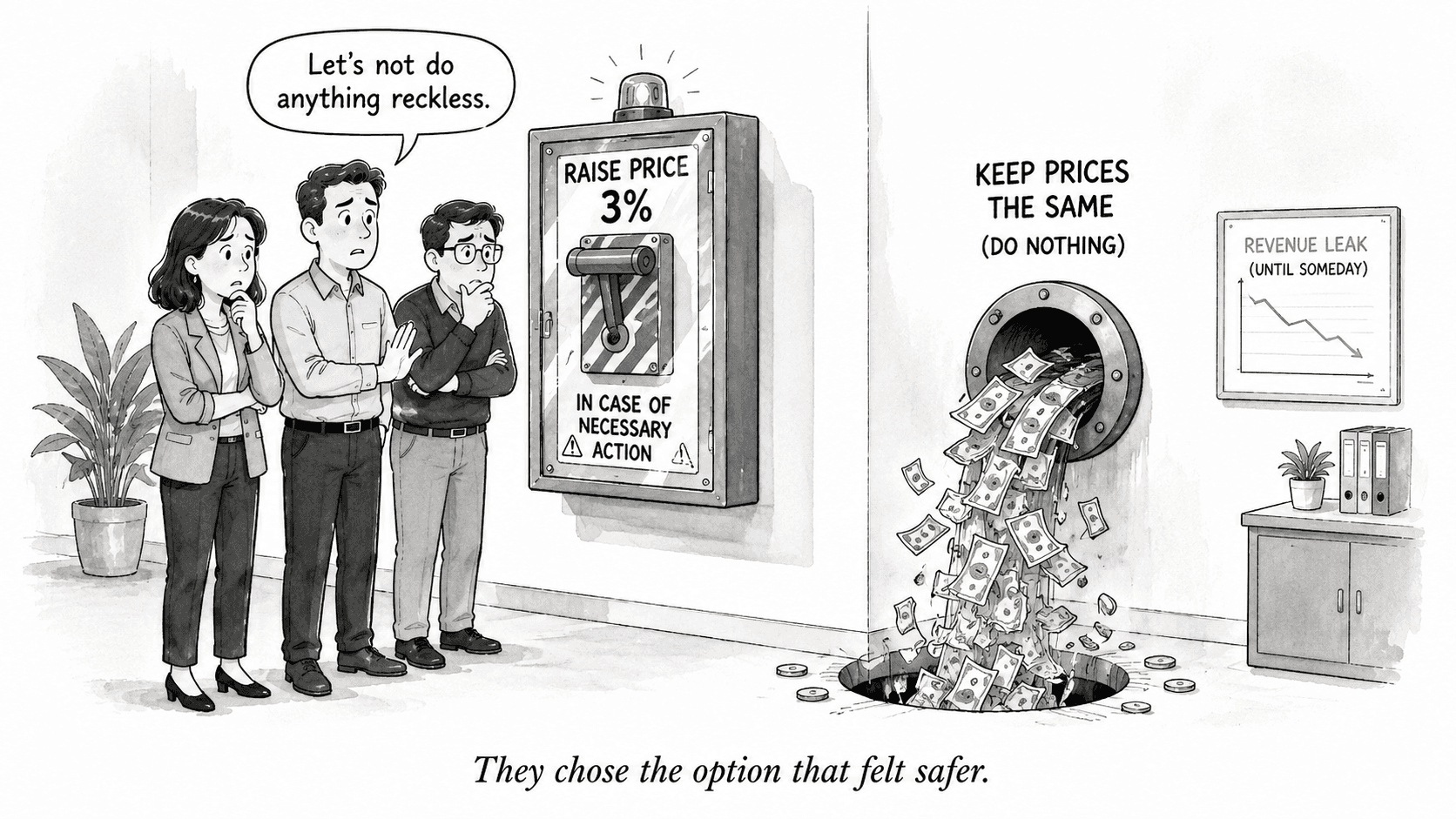
I've talked to hundreds of eCom operators about pricing. The conversation usually goes the same way.
Me: "Have you ever tested your prices?" Them: "No, but we've been meaning to." Me: "What stopped you?" Them: "Honestly? I don't know where to start."
So here's where to start. One test. One product. Two weeks.
Pick your highest-volume SKU.
Not your newest product. Not your most expensive. Your highest volume - the one with the most orders per month.
Why? Three reasons.
First, it has enough traffic for statistical significance. You need at least 1,000-5,000 visitors per variation over the test period to get reliable results. Your best seller is the one most likely to have that traffic.
Second, even a small percentage improvement on your highest-volume product has the biggest absolute dollar impact.
Third, it's the product you know best - you understand the customer, the competitive landscape, and the purchase behavior.
Test a 3-5% price increase against your current price.
Not 10%. Not 20%. A small enough change that it's barely perceptible to the individual buyer but material to your P&L at scale.
Why 3-5%? Because McKinsey's research on S&P 1500 companies shows that a 1% price increase generates an 8% increase in operating profit. At 3-5%, you're testing within a range that has enormous profit leverage but minimal psychological impact on the buyer.
A $45 product at 5% increase becomes $47.25. Most customers won't notice. But across 500 orders a month, that's an extra $1,125 in revenue - almost all of which flows to profit.
Track the RIGHT metric.
This is where most pricing tests go wrong. Teams look at conversion rate and panic when it dips 1-2%. But conversion rate alone is misleading for pricing tests.
Here's why: if your conversion rate drops 2% but your revenue per visitor goes UP (because each converting visitor is paying more), the test is a win. You're making more money from the same traffic.
The metric that matters: revenue per visitor (RPV). Calculate it as total revenue divided by total visitors during the test period. If RPV is higher in the test group than the control, the price increase is net positive - even if conversion rate dipped.
Some teams also track profit per visitor, which accounts for margin. Even better. But RPV is the minimum.
Run it for at least two weeks.
One week isn't enough. You need to capture weekday and weekend patterns, payday cycles, and enough volume for statistical significance. Two weeks is the minimum for most mid-size brands. If your traffic is lower, go three or four weeks.
During the test, don't change anything else. No new ads, no promos on the test product, no homepage redesign. You need a clean read on the price variable alone.
What happens after the test.
Scenario 1: RPV goes up, conversion stays flat. This is the best outcome. You were underpriced. Implement the increase permanently and move to the next SKU.
Scenario 2: RPV goes up, conversion dips 1-3%. This is still likely a win. Do the math: does the revenue increase from higher prices more than offset the revenue loss from fewer conversions? For a 3-5% price increase with a 1-2% conversion dip, the answer is almost always yes.
Scenario 3: RPV drops. Conversion drops meaningfully (5%+). You've found your ceiling. Good information. Your current price might actually be close to optimal, or maybe even too high. Consider testing a lower price point on this specific product.
All three outcomes are useful. There's no losing a pricing test - there's only learning.
One thing I want to address: the ethical question.
Some operators feel uncomfortable testing prices because they worry it means "different customers see different prices." This is a legitimate concern.
The way responsible pricing tests work: the higher price is shown to a random percentage of NEW visitors (say, 50%). Nobody gets a bait-and-switch. Nobody sees a price change on a product they've already viewed. The test is prospective, not retroactive. And most tools (Intelligems, Shoplift) handle this cleanly.
If this still feels uncomfortable, here's an alternative: just raise the price for everyone. If conversion doesn't drop within 2 weeks, it worked. This is less rigorous but simpler and avoids the split-test concern entirely.
The bottom line: most DTC brands have never tested pricing. Not because it's hard, but because it feels scary and they don't know where to start.
Start with one product. Test 3-5%. Watch RPV for two weeks and take a call.

